Showing posts with label Imperial easter eggs. Show all posts

Friday, September 04, 2015

Fabergé Friday

When I started writing these Fabergé Friday posts, I began by going through all the 43 surviving (of 50) Imperial Easter Eggs Fabergé created for the Russian Imperial Family. After the Russian Revolution, no more commissions for these eggs was made, for obvious reasons... But the jewel firm Fabergé still exists, and earlier this year they presented the first new Imperial Egg created in 99 years - the Fabergé Pearl Egg. It has been created to mark the 100th anniversary since the last Imperial Egg was commissioned, and Fabergé's spokeswoman, Alize Morand, says this is the first egg of several soon to be unveiled by Fabergé.


The Fabergé Pearl Egg has been hand crafted in the same manner as the original Fabergé eggs, and draws its inspiration from the formation of a pearl within an oyster. The egg is decorated with approximately 3,300 diamonds, 139 natural pearls, carved rock-crystal and mother-of-pearl set on white and yellow gold. Just like its forbearers, this egg also opens up to reveal a secret - a rare 12.17 carat grey pearl from the Arabian Gulf.


It took 20 highly-skilled craftsmen around 18 months to design, acquire the precious materials and build the egg. It was shown earlier this year at Baselworld, after which it went home to its new owner - Hussain Al-Fardan, chairman of the Alfardan Group, and founding director of Investcorp.


Friday, November 21, 2014

Fabergé Friday

For the ones of you who have been following my blog for a long time, you know I started these Fabergé Friday posts by going through all of the Imperial Easter Eggs Fabergé made for the Imperial Family. I sometimes receive a newsletter mail from the Fabergé Research Site, and the latest one contained a video that displays some of these Imperial Eggs, their little surprises and mechanics beautifully. So today I decided to post that video, so you can see for yourselves what marvelous, extremely intrinsic creations these eggs are. Enjoy the sparkle...


Friday, March 21, 2014

Fabergé Friday

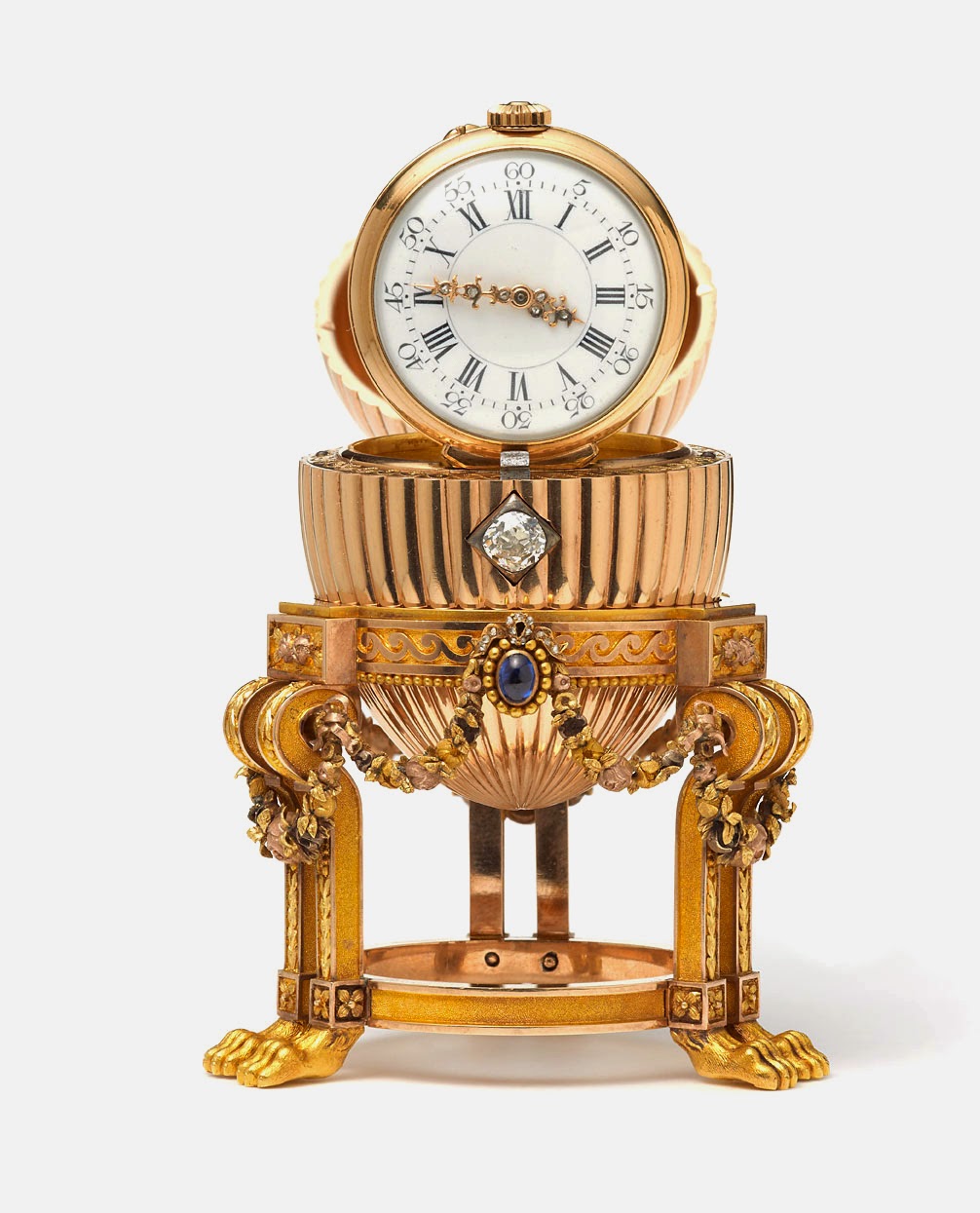
The ones of you who have followed my blog for a long time, know that I started these Fabergé Friday posts by going through all the Imperial Easter Eggs Fabergé created for Russias Tsar family. Of the fifty Easter eggs Fabergé created for the Imperial Family, eight of these are sadly lost though... Well, until recently at least. Now only seven remain hidden from the world, as one of these treasures has finally been found! Here it is! It was created by workmaster August Holmström, sometime between 1886 and 1887!


The egg is made of ridged gold, and stands on a tripod pedestal with lion paw feet. The pedestal is decorated with flower swags in colored gold, hanging from cabochon blue sapphires. A big diamond push-piece is also attached to the egg.


All of these Imperial Easter Eggs contained a little surprise, and the surprise in this egg is a lady's watch by Vacheron Constantin. It has a white enamel dial and openwork diamond set gold hands. The watch has a hinged stand inside the egg, permitting it to stand up.


The egg was given by Tzar Alexander III to Tsaritsa Maria Feodorovna for Easter 1887. It is 3.2 '' (8.2 cm) high, and it will be on display at Wartski, 14 Grafton Street, London, from 14th to 17th April 2014, between 11am and 5pm. This will be the first time in over 112 years this egg will be seen in public! But how was it found? Here comes the fun part...


An American scrap-dealer from the Midwest found the egg at a shop and bought it for 14,000 USD, thinking he could make a profit by selling the gold and the jewels on it. After finding the clock inside the egg, he googled the name of the clock maker, and so stumbled on the story about the missing Fabergé egg, described as the one he now had in his possession. He then contacted antiques expert and Fabergé specialist Kieran McCarthy, who immediately recognized the egg, and flew from Great Britain to the US to verify the authenticity of the egg. The egg turned out to be the real deal, and McCarthy said this find was like when Indiana Jones discovered the Lost Ark. He also valued the egg to 33 million USD - which of course made the profit for the scrap-dealer a "little" bit bigger than he first had counted on... It was sold to a private buyer through Wartski, the antiques firm specializing in Russian artwork that McCarthy works for.


Friday, August 31, 2012

Fabergé Friday and Full Moon

The moon is full, and what better way to celebrate than with the last Imperial Easter Egg - number fifty-six: the "Blue Tsarevich Constellation Egg", from 1917!


Due to everything that happened to Russia, and the Imperial family during WWI, this egg was never completely finished. It is made of dark blue glass, engraved with the star constellation of the day of Tsarevich Alexei Nikolaevich's birth - the Leo sign. The stars are marked by rose-cut diamonds, and the cloud-shaped base is made out of opaque rock crystal. 


Inside the egg was a clock mechanism. The clockwork and the dial - which was to be placed around the egg like a ring around a planet - are missing though, together with most of the diamond stars.


The "Constellation Egg" was long thought to be missing, but was found in 2001 at the Fersman Mineralogical Museum in Moscow.


Friday, August 24, 2012

Fabergé Friday

When the Easter of 1917 arrived, the February Revolution had already taken place, and Tsar Nicholas II had abdicated. But as usual Fabergé had still prepared two Easter eggs - one for the Dowager Empress, and one for Tsarina Alexandra - which were to be the last two Imperial Easter Eggs ever to be made...The next to last - number fifty-five - is called the "Birch Egg", or the "Karelian Birch Egg".


WWI had not been good to the Russian fortune, and the revolutionary mood of the people made it very impolitic for the royals to spend money on lavish things. This egg then, was created from Karelian birch panels set in a gold frame, and so makes it the only Imperial Easter Egg to be made out of organic material. The egg was sent to Grand Duke Vladimir Alexandrovitch, who was then supposed to give it to the Dowager Empress, but he fled from his palace before it was delivered. The gift remained, abandoned, in the palace, before it was looted during the October Revolution later that year.


The surprise is long gone. But what was once hidden inside the seemingly simple egg, was a very expensive little treasure; a mechanical elephant decorated with eight large diamonds, 61 small diamonds, and a diamond-studded key engraved "MF" (Maria Feodorovna). Since it was also stolen during the Revolution, it is probably still out there somewhere. The problem is that the owner probably has no idea of what a treasure that pretty little elephant really is...

In 2001 the "Birch Egg" publicly reappeared when a private collector from the UK - a descendant of Russian emigrants - sold it to Alexander Ivanov, who owns a Fabergé Museum in Baden Baden. When Ivanov bought the egg he also got the case that contained it, the wind-up key for the surprise, Fabergé's original invoice to Nicholas II, and a letter from Fabergé to Alexander Kerensky, complaining about not being paid and asking that the egg be delivered. 

On April 25, 1917, Fabergé had sent the Tsar the invoice for the egg. The difference in this invoice, from previous years, was that he had addressed it not to Nicholas II as "Tsar of all the Russias", but simply as "Mr. Romanov, Nikolai Aleksandrovich".


Friday, August 17, 2012

Fabergé Friday

And Imperial Easter Egg number fifty-four is: the "Order of St. George Egg", from 1916!


This egg is covered in mat opalescent white enamel, under which is painted an enamel trellis pattern of green garlands - which frames tiny St. George crosses in in white and red enamel. 


As this is yet another egg created during WWI, it keeps to the demure look of the previous "war-eggs". The Order of St. George was awarded for military bravery, and a ribbon in the Order's two colors - black and orange - encircles the whole egg, framing two medals;


One mounted with the Order of the Cross of St. George, and on the other side one in silver, chased with the portrait of Tsar Nicholas II. The egg is topped by the silver crowned monogram of the Dowager Empress.


The surprise of this egg is that the two medals can be lifted to reveal portraits of Tsarevitch Alexis - as seen here - and of Tsar Nicholas - as can be seen in the topmost picture.

The receiver of this egg was the Dowager Empress Maria, and she wrote to her son;
"I kiss you three times and thank you from the bottom of my heart for your dear postcards and the delightful egg with the miniatures that dear Fabergé himself came with. Amazingly beautiful. It is so sad not to be together. I wish you, my dear Nicky with all my heart, all the best things and success in everything. Your warmly loving, old Mama."

The "Order of St. George Egg" was one of nine Imperial Easter Eggs bought by Viktor Vekselberg, for almost 100 million USD, in 2004.


Friday, August 10, 2012

Fabergé Friday

There aren't so many Imperial Easter Eggs left now. But we still have a few! Like number fifty-three for example: the "Steel Military Egg", from 1916!


This egg is made of steel, around which sits gold decorations in the form of the Russian double-headed eagle, Tsarina Alexandra's monogram, and an image of George the Conqueror. The egg is resting on the points of four miniature artillery shells, which - in their turn - stands on a base of nephrite. The whole piece is also topped with a gold crown.

The simple look of this egg is - yet again - caused by the ongoing WWI. All Fabergé's craftsmen were out fighting in the war, which led to the closing of his workshops. Gold and silver was not allowed to be used by jewelers, who instead turned to steel, brass and copper. In a time like this it was also bad for the Imperial family to publicly be seen ordering expensive things.


The surprise inside the egg is a miniature painting, made by Vassily Zuiev. Painted on ivory is a depiction of Tsar Nicholas II and his son, consulting with officers at the front. The miniature is surrounded by a frame of gold and white enamel, held up by a small easel. 

The "Steel Military Egg" is one of ten Imperial Easter Eggs that was never sold, and can now be found in the Kremlin armory.


Friday, July 27, 2012

Fabergé Friday

And Imperial Easter Egg number fifty-one is: the "Red Cross with Triptych Egg", from 1915!


The simple look of this egg was because WWI had begun. The gold shell is covered in opalescent white enamel, and then decorated with a translucent red enamel cross on each side. In the middle of the two crosses are miniature portraits of the Grand Duchesses Olga and Tatiana, dressed in their Red Cross uniforms. 


The cross with Tatiana's portrait serves as a clasp, that opens the egg up vertically to reveal the surprise - a triptych. The center scene is depicting "The Harrowing of Hell" - the Orthodox representation of the Resurrection.


On the left wing is Saint Olga - the founder of Christianity in Russia - depicted, with the crown monogram of Tsarina Alexandra inscribed on the door.


The right wing holds a picture of the martyr Saint Tatiana, and the year "1915" inscribed on the door.

The "Red Cross with Triptych Egg" can now be seen at the Cleveland Museum of Art in Ohio, USA.


Friday, July 20, 2012

Fabergé Friday

It's amazing how many Imperial Easter Eggs Fabergé made! The funny thing is that Carl Fabergé himself actually never physically made anything - he "only" came up with the ideas and designs. But now to this Friday's egg - number fifty - which is the "Catherine the Great Egg", or "Grisaille Egg", from 1914!


This gold egg was inspired by the interior of Maria Feodorovna's favorite palace - the Anichov Palace - where many of the ceilings are painted en grisaille. 


On pink enamel panels designer Vasilii Zuev painted miniature allegories portraying the arts and sciences - after originals by Francois Boucher - in cameo style. The egg is also decorated with rosettes of platinum-set diamonds and seed pearls, and is lined with velvet.


The surprise has been lost, but in a letter to Queen Alexandra of England Maria wrote: "Mr. Fabergé himself has brought me this most beautiful egg. Inside is a sedan chair carried by two blackamoors with Catherine the Great in it, wearing a little crown on her head. You wind it up and then the two blackamoors walk: it is an unbelievably beautiful and superbly fine piece of work. Fabergé is the greatest genius of our time."


This similar piece - also made by Fabergé - might give you a sense of what it might have looked like. It belongs to the Forbes Collection, and was for a long time thought to be the missing surprise. That idea was given up when it was discovered this automaton didn't fit into the egg though. 


Here is another example of how the sedan chair could have looked. Catherine the Great was a great  patron of the arts and sciences, and so fitted well into the egg's design.

The "Catherine the Great Egg" can now be seen at the Hillwood Museum in Washington D.C.


Friday, July 13, 2012

Fabergé Friday

We have now reached Imperial Easter Egg number forty-nine: the "Mosaic Egg", from 1914!


This egg is made of several yellow gold belts, that hold together a platinum network partially pavé-set with diamonds, sapphires, rubies, emeralds, topaz quartz and green garnets to resemble petit point tapestry work, partially completed. 


Where no gems are set you can actually look straight through the egg. The decoration also include rows of half-pearls within lines of opaque white enamel, diamonds, and a moonstone set at the top, under which can be seen the Tsarina's gold initials - in Russian characters - inlaid in an opaque, pale pink plaque serving as a foil.


The surprise - held in place inside the egg with two gold clips - is a miniature frame holding the profiles of the five Imperial children, painted in camaieu brun on an opalescent pink enamel ground on one side...


...and the names of the children, a basket of flowers and the year "1914" in enamel on the other side. The frame itself is made of pearls and green enamel husks, with an Imperial crown set with rose-cut diamonds on top. The oval base and white enamel vase-shaped pedestal is decorated with diamonds, emeralds and two suspended pearls. 

The "Mosaic Egg" is part of the Royal Collection of Queen Elizabeth.


Friday, July 06, 2012

Fabergé Friday

Here comes one of my favorite Imperial Easter Eggs, number forty-eight - the "Winter Egg", from 1913!


This egg has been thinly carved out of rock-crystal. On the interior it is finely engraved to simulate ice crystals. The outside has also been engraved, and in these channels rose-cut diamonds in platinum are set. On top sits a cabochon moonstone with the year "1913" painted on the reverse side. The egg can be removed from it's base - shaped as a block of melting ice. This base is also made from rock-crystal, with rivulets of platinum set rose-cut diamonds. 


The egg is hinged, with diamonds encircling the whole opening. When opened it reveals the surprise - a double-handled platinum basket set with diamonds, hanging on a platinum hook. The basket is full of wood anemones, each carved - some open, some half-open or in a bud - from a single piece of white quartz, with a demantoid garnet in the center. The leaves are made of nephrite, and the flower's stems, and the moss they sit in, are gold wire. The base of the basket is engraved with "Fabergé 1913" in Roman letters.


With 1,660 diamonds on the egg, and 1,378 on the basket, the "Winter Egg" is the most expensive Imperial Easter Egg ever made. In 1913 the price was 24,700 rubles (752 USD today). In 2002 it sold at an auction at Christie's in New York City for 9.6 million USD. The buyer was the Emir of Qatar.


Friday, June 29, 2012

Fabergé Friday

We have now reached Imperial Easter Egg number forty-seven - the "Romanov Tercentenary Egg", from 1913!


In 1913 the 300th anniversary of the Romanov Dynasty was celebrated, and this egg was made to commemorate the event. The gold egg is faced with white transparent enamel on a guilloche background. This surface is almost covered in over 1100 diamonds and gold state symbols though. There are double-headed eagles, royal crowns, and wreathes. But there are also eighteen miniatures, framed with diamonds, of the Tsars of the house of Romanov. These are painted in watercolor on ivory by Vassily I. Zuev. At the top of the egg sits a large diamond with the years "1613" and "1913" engraved under it, and at the bottom sits a triangular diamond covering the monogram "A.F.". The portraits are as follows:

Mikhail Feodorovich 1613-1645

Alexei Mikhailovich 1645-1676

Feodor Alexeevich 1676-1682

Ivan V 1682-1696

Sofia Alexeevna 1682-1689

Peter The Great, Tsar 1682-1721,
 Emperor of Russia 1721-1725

Catharine I 1725-1727

Peter II 1727-1730

Anna Ivanova 1730-1741

Elizaveta Petrovna 1741-1761

Peter III 1761-1762

Catherine the Great 1762-1796

Paul I 1796-1802

Alexander I 1801-1825

Nicholas I 1825-1855

Alexander II 1855-1881

Alexander III 1881-1894

Nicholas II 1894-1917


The egg is held by a threefold heraldic eagle, symbolizing the power and glory of the Romanov Dynasty. The eagles are holding the Imperial scepter, orb and the Romanov sword in their talons. The purpurine base on which they stand represents the Russian Imperial shield. 


The inside of the egg is decorated with white opalescent enamel on a ground carved with guilloche ornaments. The surprise is a rotating globe, made of burnished blue steel - to represent water - and different colored gold - to represent land. The globe consists of two northern hemispheres. One half shows Russia's territory at the time when the first Romanov Tsar - Mikhail Feodorovich - entered the throne in 1613. And the other shows the territory of the Russian Empire in 1913, when Nicholas II ruled.

The "Romanov Tercentenary Egg" is one of ten Imperial Easter Eggs in the collection at the Kremlin Armory.


Hyper Smash