Showing posts with label Kelch Eggs. Show all posts

Friday, October 19, 2012

Fabergé Friday

And so we have come to the last of the Fabergé eggs that were created for the Kelch Family - egg number seven: the "Chanticleer Egg", from 1904!


This egg is in fact a clock. The surface is covered in translucent royal blue enamel over a guilloché ground. It is then decorated with swags of green gold laurel tied with red gold ribbons. Around the center of the egg runs a girdle of pearls. The dial is white enameled, painted with green and red garlands, and surrounded by a frame of seed pearls. 

The base, on which the clock stands, is enameled in oyster and royal blue, and decorated with different colored gold. The four sides are decorated with a love trophy, a cornucopia, and two music trophies.


At the top of the egg sits a hinged gold door, that is opened to reveal the surprise - an enameled gold rooster (chanticleer) set with diamonds. When the hour is crowed it moves it's head, wings, and beak. The entrance to the complex mechanisms of the clock can be reached through a round, intricately pierced gold door on the back of the egg. 

The "Chanticleer Egg" can now be found in the Vekselberg Foundation, Russia. 


Friday, October 12, 2012

Fabergé Friday

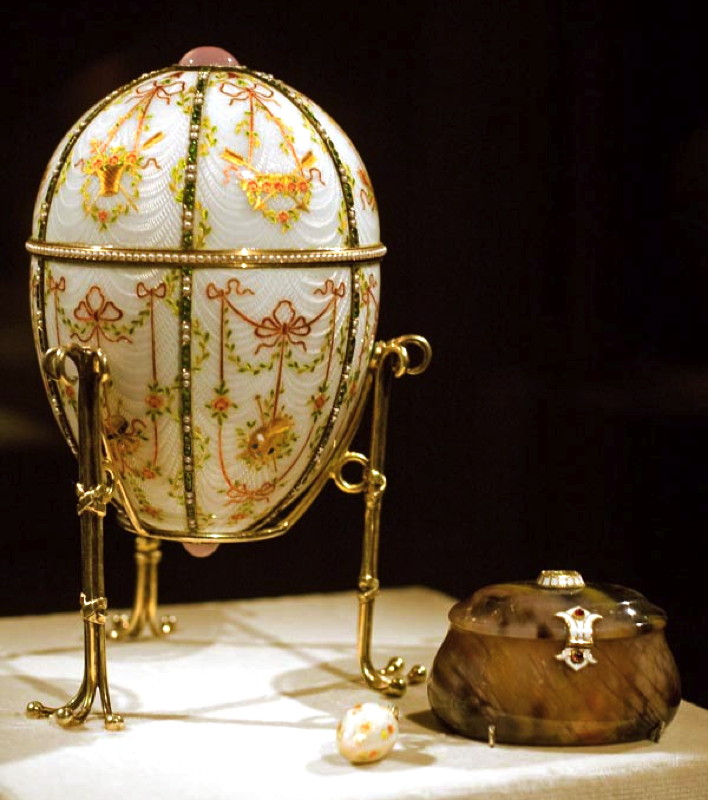
There are two more Fabergé eggs that were made for the Kelch family, and the sixth one in their collection is called the "Bonbonnière Egg", from 1903!


This egg is made of translucent opalescent white enamel over a guilloché ground. Gold bands encrusted with demantoid garnets and seed pearls divides the surface into twelve panels. These panels are then decorated with neoclassical flower and bow motifs. In both ends of the egg sits a cabochon stone, surrounded by rose-cut diamonds. 

Inside the egg the surprise can be found, lying in a fitted compartment lined with velvet - a miniature bonbonnière box made of agate. On top of the lid sits a rectangular portrait-cut diamond covering the date "1903" in white enamel. The little box is also decorated with cabochon rubies. Inside the bonbonnière another surprise is to be found - a tiny, egg-shaped pendant made of gold and enamel.


If you compare the "Bonbonnière Egg" with the "Gatchina Palace Egg" (above) that Fabergé made for the Imperial Family in 1901, great similarities can be seen. Although the Kelch version is unmarked, Mikhail Perkhin was probably the creator of both of these eggs. 

After not being sold when offered by a private US owner at Christie's, New York, in 1990, it was still sold after the auction to an anonymous buyer somewhere in the world... 


Friday, October 05, 2012

Fabergé Friday

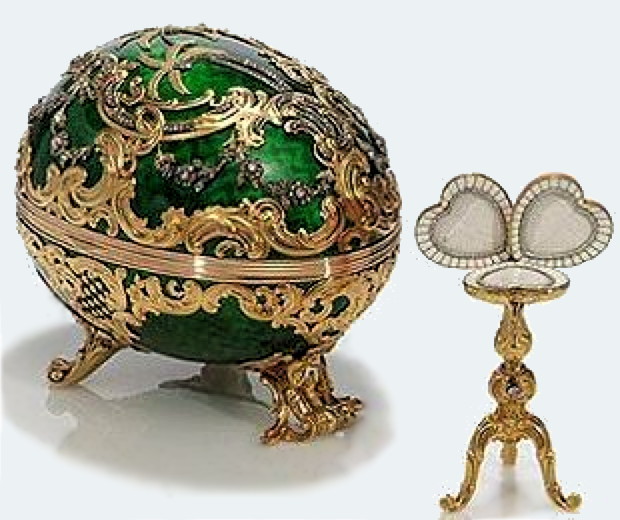
There are still some Fabergé eggs made for the Kelch-family we haven't looked at yet. Here is number five: the "Rocaille Egg", from 1902!


This egg is covered in a deep green enamel. The surface is then decorated with gold rococo cartouches, platinum flowers set with diamonds, and varicolored gold palms, also encrusted with diamonds. 


The egg rests on three scrolled gold feet, and on the inside we find the surprise - a gold tripod surmounted by a heart enameled translucent rose. On one sides the initials "B.K." (Barbara Kelch) are set in diamonds, and on the other side the year "1902".


The heart can be opened, and then reveals three small frames. The miniatures originally contained in them are missing though.

In 1997 the "Rocaille Egg" was sold to a US buyer in a private auction arranged by dealer Proler of Dallas.


Friday, September 28, 2012

Fabergé Friday

We have now reached number four in the line of Kelch-eggs: the "Apple Blossom Egg" or "Jade Chest Egg", from 1901!


The thin, polished surface of this egg is made from one solid piece of carved nephrite. It stands on four "branches" made of red and green gold. These branches then grow up over the egg as interlacing twigs with nots, veins, patches of moss, gold leaves and flowers with white-pink enamel petals and silver-mounted, pink foiled rose-cut diamonds. 


The design of the egg reflects the contemporary fashion of Art Nouveau and the Japanese style. This is one of the biggest eggs ever created by Fabergé, and it was designed as a jewelry case. The surprise inside is lost though.

The "Apple Blossom Egg" now belongs to Adulf Peter Goop, Vaduz, Lichtenstein.


Friday, September 21, 2012

Fabergé Friday

We have now reached number three of the Kelch family's Fabergé eggs: The "Pine Cone Egg", from 1900!


The pine cone is a symbol of resurrection, and this one is covered in translucent royal blue enamel over a sunburst guilloché ground, encrusted with rose-cut diamonds mounted in platinum. The date "1900" is written at one end, and covered in quatrefoil made of four pear-shaped diamonds. 


When opened into two halves, the egg reveals a fitted velvet compartment that holds the surprise - an oxidized Indian elephant automaton. The tiny animal is made of silver, gold, red and green enamel, and has tusks made of ivory. Each side of it is set with three rose-cut diamond collets, one which covers a key hole. On top of the elephant sits an enamel turbaned mahout upon a gold fringed, red and green guilloché enamel saddle cloth. The original gold key is still in place, and when wound up the elephant lumbers forward, shifting its weight from one side to the other, while at the same time turning its head and wagging its tail.


These sorts of Fabergé easter eggs were made for only a few customers, apart from the Imperial Family, and the Kelches were probably Fabergé's wealthiest private patrons.

In 1997 the "Pine Cone Egg" was offered by Christie's, New York, from the collection of Joan Kroc, but did not sell at the highest bid of 2.8 million USD. The presale estimate was 3.5 to 4.5 million USD.


Friday, September 14, 2012

Fabergé Friday

After last week's relief over the fact that these Fabergé Fridays hadn't come to an end, but that there were actually more of these lovely creations, I will try to stay away from chocking you all for a while. It would be horrible to lose readers because of heart attacks I inflicted on you myself! If that's the way you want to go, please go watch a scary movie or something instead...

Well, well. Enough about that! Now to this week's Fabergé egg, which is the second one made for the Kelch family, called the "Twelve Panels Egg", from 1899!


Both the upper and lower part of this egg is divided into six white enameled sections each. The dividing bands of matt-finished gold is overlaid with pink enamel roses with gold stems and translucent green leaves. The two halves of the egg is divided by a row of rose-cut diamonds, at intervals set with rosettes of additional diamonds. 


Both ends of the egg is decorated with concentric circles of diamonds, gold and green enameled leaf motives, and pink enamel. At the center of the top end sits a medallion bearing the initials "B.T.K" under a portrait diamond. The other end holds a similar, but smaller medallion, showing the year "1899".


The white enamel panels are inlaid with blue motives, which gives the egg the impression of being made of porcelain. The surprise inside the egg has been lost.

In 1933 King George V of England became the owner of the "Twelve Panels Egg", and gave it as a Christmas gift to Queen Mary. In 1953 Queen Elizabeth II inherited the egg, which still remain in the Royal Collection.


Friday, September 07, 2012

Fabrgé Friday

Ok. Just because I said last Friday's egg was the last one of the Imperial Fabergé eggs, that doesn't mean it was the last of all of his eggs! Just like clothes and other things celebrities wear and buy today gets popular among the "lesser" people, so it was with royals and their fans back in the day. So when people discovered what a luxurious Easter tradition the Imperial family had started, of course they wanted some Fabergé eggs of their own!

To be able to pay for these extremely expensive eggs you had to be pretty rich though, and one of the families who could afford this was the Kelch family. Starting in 1898, Alexander Kelch gave his wife, Varvara, Fabergé eggs as Easter presents during seven years. These eggs were modeled on the Imperial series, and since Varvara was the one with money in that marriage, she was in the end no doubt the one paying for these "gifts" herself...

So, now to the first of the Kelch-eggs: the "Hen Egg", from 1898!


This egg is covered in strawberry red enamel, over a guilloché ground. It opens horizontally, with a diamond-set border encircling the whole egg. The opener is a table diamond, covering the year "1898".


The interior is enameled white, with a hinged matted enamel "yolk", lined with suede. When the yolk opens up it reveals gold, diamond-eyed hen enameled in translucent shades of orange, yellow, red, and brown. The feathers have white highlights, and the legs are naturalistically chased. At the tail of the hen sits even one more hinge, and when lifted it reveals a gold easel set with rose-cut diamonds - which legs and diamond and ruby-set crest can be folded in towards the back, to fit in the little hen. From the beginning the frame held a miniature of Varvara Kelch, but now this has been exchanged to a portrait of the Tsarevich Alexei wearing the uniform of the Fourth Rifle Battalion of Guards. 

The Kelch "Hen Egg" can now be found in the Viktor Vekselberg Collection in Moscow.


Hyper Smash