Showing posts with label Viktor Vekselberg. Show all posts

Friday, December 07, 2012

Fabergé Friday

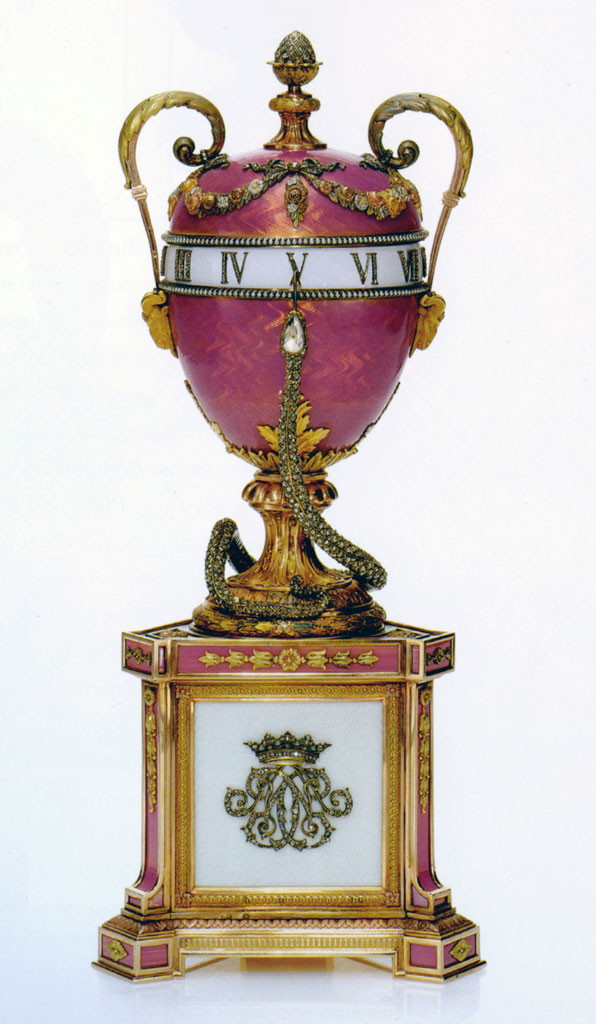
The next Fabergé easter egg in line is the only one commissioned by an American - Consuelo Vanderbilt, Duchess of Marlborough, niece to Biltmore Estate's creator George Washington Vanderbilt. The egg she ordered is called the "Duchess of Marlborough Egg", or "Pink Serpent egg", and it was created in 1902!


This egg is enameled translucent rose pink over a gold guilloché ground, and decorated with multi colored gold ornaments. As you can see this is one of Fabergé's clock eggs. The dial, which surrounds the whole egg is white enameled, with diamond-set Roman numerals. A diamond encrusted snake winds up from the gold pedestal, with it's arrow-tounge indicating the time. The triangular pedestal is enameled oyster. One of it's sides is decorated with the diamond-set monogram of Consuelo. The other two sides are applied with a varicolored gold cornucopia, and a gold trophy. 

Source

In 1902 Duchess Consuelo (pictured above) travelled to russia with her husband to attend the Bal des Palmiers, where she was the dinner companion of Tsar Nicholas II.  "With the entrance of the Imperial Family to the inspiring air of the Russian anthem - the procession of grand dukes in splendid uniforms, the grand duchess, lovely and bejeweled, the beautiful remote Tsarina and the Tsar - the ball took on the aspect of a fairy tale", she wrote of the occasion. She also remembered to have dined on "gold and silver plate fashioned by Germain, chased and beautiful in shape and color".

During this visit she also visited the Dowager Empress at Anchikov Palace, and most probably saw the Emperess' collection of Fabergé eggs - including the "Blue Serpent Clock Egg", from which she probably got the idea for the egg she ordered from Fabergé herself. 

After her divorce from Marlborough, Consuelo donated her egg to a charity auction in 1926. The buyer was Polish soprano Ganna Walska. Today the "Duchess of Marlborough Egg" belongs in the collection of Viktor Vekselberg.


Friday, November 23, 2012

Fabergé Friday

Next Fabergé egg in line is called the "Scandinavian Egg", or "Quisling Egg", and it was made between 1899 and 1903!


This egg is one of several Fabergé created on the theme of the hen and her egg. The outside is covered in translucent strawberry-red enamel. The only decoration is an ornamental gold ring that encircles the whole egg.


The surprise is an enameled gold hen, painted in realistic colors, and with diamonds for eyes. The yolk in which the hen lies is made of suede.

The "Scandinavian Egg" was rediscovered in 1980 in a bank safe in Oslo belonging to Maria Quisling, who died that same year. She was the widow of Vidkun Quisling who was the son of Jon Quisling. Jon - who was a major in the Norwegian Army - had probably acquired the egg when he was working as a Military Attaché in St. Petersburg in 1918 and 1919. 

This egg can now be found in Viktor Vekselberg's collection.


Friday, November 02, 2012

Fabergé Friday

Another Fabergé egg that wasn't made for either the Kelch family or the Imperial Family, is the "Spring Flowers Egg", created somewhere between the years 1886-1896!


This egg is covered in strawberry-red enamel over a guilloché ground. Over it's surface runs gold ornaments in the Louis XV style. Encircling the egg from top to bottom is a line of rose-cut diamonds, ending in a diamond set clasp at the top. The base is made of pale green bowenite, decorated with diamonds, and resting on a scrollwork in gold. 


When opening the clasp on top of the egg, the two sides divides to show the surprise - a diamond-set platinum basket full of windflowers, or wood anemones. The flowers are made of white chalcedony, with demantoid garnet centers, and engraved gold stems. Between the flowers you can also see green enamel leaves. 


The "Spring Flowers Egg" is now part of the Viktor Vekselberg Collection.


Friday, September 07, 2012

Fabrgé Friday

Ok. Just because I said last Friday's egg was the last one of the Imperial Fabergé eggs, that doesn't mean it was the last of all of his eggs! Just like clothes and other things celebrities wear and buy today gets popular among the "lesser" people, so it was with royals and their fans back in the day. So when people discovered what a luxurious Easter tradition the Imperial family had started, of course they wanted some Fabergé eggs of their own!

To be able to pay for these extremely expensive eggs you had to be pretty rich though, and one of the families who could afford this was the Kelch family. Starting in 1898, Alexander Kelch gave his wife, Varvara, Fabergé eggs as Easter presents during seven years. These eggs were modeled on the Imperial series, and since Varvara was the one with money in that marriage, she was in the end no doubt the one paying for these "gifts" herself...

So, now to the first of the Kelch-eggs: the "Hen Egg", from 1898!


This egg is covered in strawberry red enamel, over a guilloché ground. It opens horizontally, with a diamond-set border encircling the whole egg. The opener is a table diamond, covering the year "1898".


The interior is enameled white, with a hinged matted enamel "yolk", lined with suede. When the yolk opens up it reveals gold, diamond-eyed hen enameled in translucent shades of orange, yellow, red, and brown. The feathers have white highlights, and the legs are naturalistically chased. At the tail of the hen sits even one more hinge, and when lifted it reveals a gold easel set with rose-cut diamonds - which legs and diamond and ruby-set crest can be folded in towards the back, to fit in the little hen. From the beginning the frame held a miniature of Varvara Kelch, but now this has been exchanged to a portrait of the Tsarevich Alexei wearing the uniform of the Fourth Rifle Battalion of Guards. 

The Kelch "Hen Egg" can now be found in the Viktor Vekselberg Collection in Moscow.


Friday, June 08, 2012

Fabergé Friday

This Friday's Imperial Easter Egg comes in place number forty-four, and is called the "Bay Tree Egg", or "Orange Tree Egg". It's from 1911!


This egg is shaped like a bay - or orange - tree, which foliage is made of finely engraved nephrite leaves. Among these leaves sits white enamel flowers with diamond pistils, and citrine, amethyst, ruby and champagne diamond berries.


The tree grows out of a quartz tub, decorated with a gold trelliswork, green laurel swags suspended from rubies, and filled with hammered gold soil. The tub itself stands on a nephrite base with four nephrite posts, connected by swags of green enamel leaves and pearls. 


The surprise is yet again one of Fabergé's amazing automatons! If the correct "berry" on the tree is turned, a portion of the foliage on the top opens up, and a little nightingale - covered in real feathers -  emerges singing while moving its head, wings and beak.


Inside the egg a little bellows produces the birdsong, as the whole tree revolves on its trunk. When the song ends, the bird automatically returns down into its nest. 

The "Bay Tree Egg" was based on a mechanical, 18th century bay tree by the French jeweler and clockmaker Richard. This egg can now be seen in the Vekselberg collection, after Viktor Vekselberg bought it in 2004, as one of nine Imperial Easter Eggs, for which he payed almost 100 million dollars...


Friday, January 20, 2012

Friday Fabergé

The next Imperial Easter Egg in line - the "Mauve Egg" - is yet again one of the lost ones. But it is described as a mauve enamel egg with three miniatures, and was given by Tsar Nicholas II to the Dowager Empress Maria Feodorovna in 1897.


It's surprise, which still exists though, is a heart shaped photo frame, made of strawberry red, green and white enamel, rose-cut diamonds, pearls, and watercolor on ivy.


It opened as a three-leafed clover with each leaf containing the pictures of Nicholas II, his wife Empress Alexandra Feodorovna, and their first child, Grand Duchess Olga Nikolaevna.

The seventeenth egg still exists though, and I think this might actually be my favorite, just because I love lilies-of-the-valley so much. The name of this egg is - as it should be - the "Lilies of the Valley Egg"!


This Art Nouveau egg is made of pink enamel covered gold, with gold-stemmed pearl lilies-of-the-valleys, set with diamonds and rubies, and surrounded by green enamel leaves. It is supported on four dull green gold cabriole legs, composed by overlapping leaves veined with rose-cut diamonds. On top of the egg sits an Imperial Crown, covered in rose-cut diamonds and a cabochon ruby.


When lightly depressed the crown generates a mechanical device inside the egg, that raise the surprise out of the top. This surprise is a fan of three tiny miniatures painted by Johannes Zehngraf. The miniatures depict the Tsar Nicholas II, and his first two daughters, Grand Duchesses Olga and Tatiana. These are framed by rose-cut diamonds and backed with gold panels, engraved with the presentation date - April 5, 1898. A turn in the opposite direction automatically folds and returns the miniatures back into the egg.


Fabergé tried to learn something about the private lives of his most important clients, so he knew the Empress' favorite color was pink, pearls were her favorite gems, and her favorite flower was the liliy-of-the-valley, so this egg must have fitted her mind perfectly! Every spring, Alexandra would fill the palaces with bouquets of these lovely flowers. Walking through those rooms must have scented amazing...

The "Lilies of the Valley Egg" now exists in the collection of Viktor Vekselberg.


Hyper Smash